
By Ashley Johnson, MS
For over two decades I have operated as a professional athlete and coach in the sport of three-day eventing – a sport that requires mental stamina, grit, and resilience. I ran in my first advanced level event in 2002 and since then I have competed seven horses at the advanced level, including one at the CCI5* level. I have also competed in upper-level dressage and show jumping competitions, and run my equestrian business, Ashland Equestrian, which takes its own type of mental fortitude.
Simultaneously, I have always loved to teach, and with thousands of hours of giving instruction under my belt, I have seen clearly how important a rider’s mental state is to having a successful ride, be it a training ride, a lesson, or a competitive outing. This prompted me in 2018 to return to graduate school to study performance psychology. In 2020, I founded Empower Performance Coaching and began running performance psychology workshops and taking on one-on-one clients.
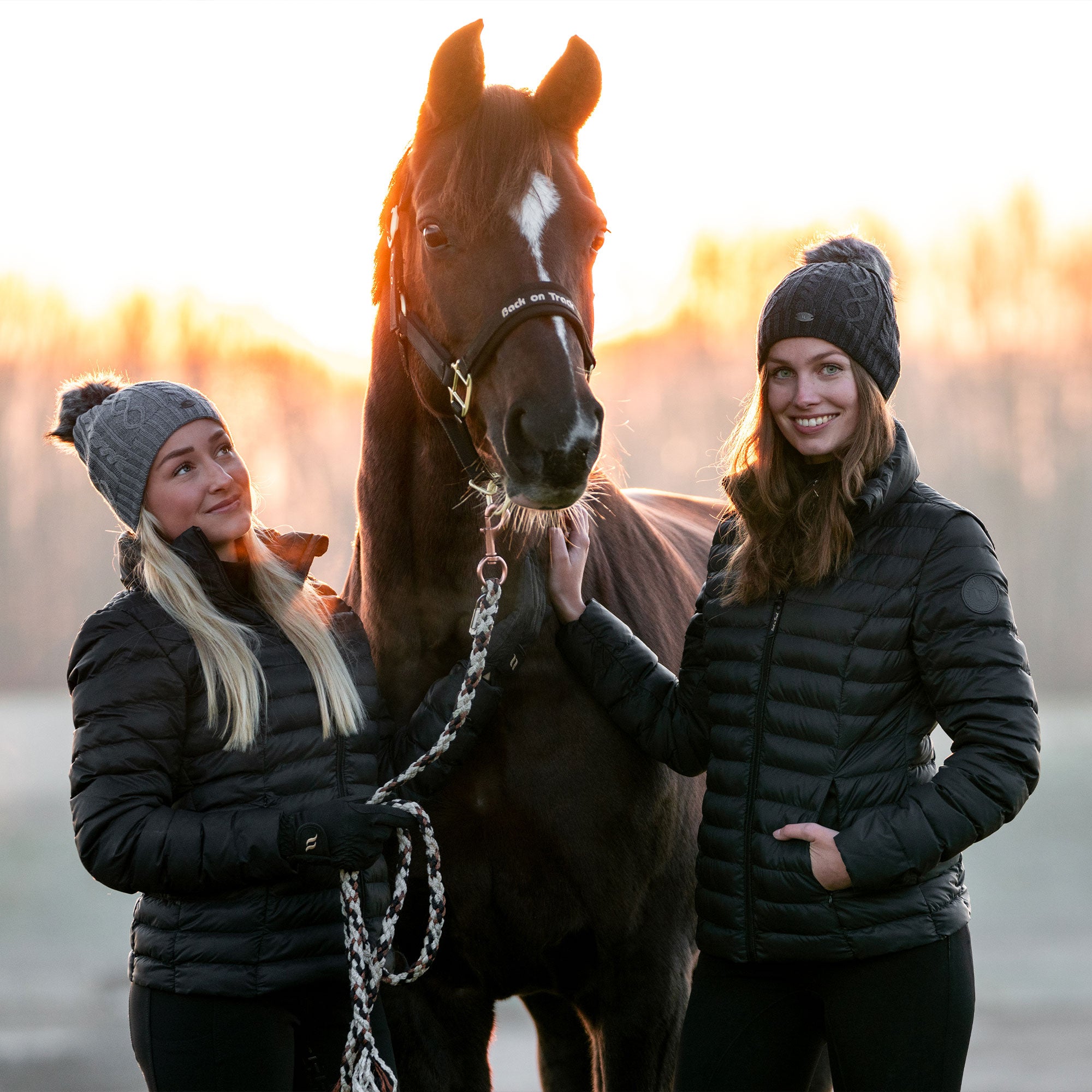
These combined experiences have solidified for me the importance of the strong mental skills needed by equestrians. Riding is truly a unique sport. Not only do we as riders have to develop our own skills as equestrian athletes, but we have to work in partnership with a 1,200-pound animal who can instinctively sense our nervous system (Hama, Yogo, & Matsuyama, 1996)[2]. In fact, did you know that horses can tell if we are unhappy, nervous, or relaxed just simply by reading our facial expressions (Smith, Proops, Grounds, Wathan, & McComb, 2016)[4]? With this in mind, developing effective mental skills in equestrian sport is crucial for riders at all levels in order to unlock our potential. Here are the skillsets that I return to again and again when helping riders who want to master peak mental states.
Nervous System Regulation
Our nervous system, honed to keep us safe from danger, operates on an instinctual level. In his book The Chimp Paradox (2012) by psychologist Dr. Steve Peters, Peters describes a simplified but useful model of the human brain wherein the chimp represents the limbic system, which houses the emotional, survival-focused, impulsive and fast-reacting part of our brain. On the other hand, we also have a prefrontal cortex, which is the more logical and rational part of our brain, which has developed more recently in evolutionary terms. Peters calls this the human brain. Lastly, he describes the parietal lobe of the brain as the computer that stores our automatic and habitual responses to situations.
As riders, we often feel intense pressure or anxiety in certain situations. Peters argues that the chimp ‘hijacks’ our emotional state because it operates approximately five times faster than our human brain. In addition, we may have ingrained (sometimes trauma based) responses to pressure, so when we feel triggered by an emotion, our chimp checks in with the computer to see how we have traditionally responded, and cycles repeat. In order to manage these cycles, we need to use our human brain to feed our computer new information. We do this by challenging old patterns and using rational thought to slow down our limbic response.
One example of this from a performance psychology perspective is to frame pressure as a privilege. In essence, when we feel what we would traditionally perceive as negative anxiety emotions, riders can remind themselves that their nervous system is doing its instinctual job, and they can adopt a sense of gratitude for the pressure, because pressure means that we are attempting something hard or challenging. In her article Heal Anxiety by Retraining your Brain (2022)[1], Dr. Susan Biali Haas, M. D. describes reflexive questions that we can ask ourselves to further facilitate the retraining process, such as “Where did that fear come from? What’s true about it? What’s not true about it?” You can read her full article here. Ultimately, as athletes, we need to move into the fear and become comfortable challenging it. Over time, this helps to re-attune our nervous system.
Breathwork
One of the most important skills that we can hone as equestrian athletes is mindfulness or being aware in the present moment. When mindfulness is mastered, riders often can access flow state. Flow state is the sweet spot where we’re so absorbed in what we’re doing that everything else drops away. Time flies or disappears, focus feels effortless, and we have the sense that we are performing at our best. In a study that Dr. Shelley Carson and I published in 2025[3], we found a link between flow state and resilience in equestrian athletes. Consistent breathwork is a core foundation of developing mindfulness and flow. Here are two of my favorite techniques.
The Body Scan
After mounting your horse, walk quietly and focus on your breathing. Gradually move your attention through your body, starting from your toes and moving up to your head, taking a deep breath in and out in each area. Notice tightness or discomfort. When you find a blocked area, take a deep breath in through your nose and out through your mouth. Imagine that you are breathing in blue, relaxing air, and that you are breathing out red, fiery air. Allow your breath to consciously relax the tense muscles and then move to the next area of your body. As you ride, periodically perform a quick body scan to ensure you are breathing deeply and staying relaxed and connected with your horse’s movements. In equestrian sport, our connection with our horse is key. A simple body scan can help us spot tension and then breath through it to let it go -- which makes it easier to feel truly in sync!
Roller Coaster Breathing
Roller coaster breathing is a simple way to calm your body. It can be used while you are riding or on the ground. Use this breathwork technique in preparation for a ride or a performance, when you feel anxious or frustrated, during challenging moments, or after a mistake (to reset without spiraling). This breathing technique uses the visual of a roller coaster to help keep you focused. First, inhale slowly through your nose like you’re climbing the hill of a roller coaster. Feel that you are expanding your rib cage and allowing your diaphragm to drop, creating space for your lungs to fully expand. There is no set number here, but breathing in often takes 3-4 counts. Pause briefly and naturally at the top. Then, exhale smoothly (often 4-6 counts) through your nose or your mouth as you roll down the other side. Picture your body relaxing and your nervous system resetting. Each cycle should feel fluid and unforced. Just a few breaths like this can help release tension and bring your focus back to the present moment. Paying attention to your breath allows you to anchor yourself in the present moment, grounding your mind and body. This is especially valuable in equestrian sport, as it helps you maintain composure, regulate emotions, and synchronize with your horse. By incorporating breathwork exercises into training and competition routines, riders can boost performance, improve connection with their horse, and find a sense of calm when their brain wants to go into overdrive.
Conclusion
There are many ways to build strong mental skills as an equestrian athlete. What is important is to have a system in place. Nervous system regulation and breathwork techniques give riders tools to face different situations with confidence and greater cognitive control. With a consistent mental practice in place, riders can learn how to respond skillfully to whatever unfolds, and over time develop more clarity and intention in their riding. In equestrian sport, consistent mental training becomes the bridge that helps us take our riding to the next level!
To learn more or to connect with me, please visit www.empowerperformancecoaching.com or email me at alequestrian@gmail.com.
References:
- Biali Haas, S. (2022, December 16). Heal anxiety by retraining your brain. Psychology Today.
- Hama, H., Yogo, M., & Matsuyama, Y. (1996). Effects of stroking horses on both humans' and horses' heart rate responses. Journal of Psychological Research, 38 (2): 66–73.
- Johnson, A. E., & Carson, S. (2025). Flow state, resilience, and performance strategies in elite three-day eventing equestrian athletes. Comparative Exercise Physiology, 21(1), 63-70. Peters, P. S. (2012). The chimp paradox. Vermilion.
- Smith, A. V., Proops, L., Grounds, K., Wathan, J., & McComb, K. (2016). Functionally relevant responses to human facial expressions of emotion in the domestic horse (Equus caballus). Biology letters, 12(2), 20150907.