
When you buy a riding helmet, what do you look for?
Fit? Style? Ventilation? Price?
Here’s another question every rider should be asking:
What safety standards does this helmet meet — and what do those standards actually test?
At Back on Track USA, we believe riders shouldn't have to choose between a helmet that looks good and one designed with safety at the forefront. But we also believe riders should understand the science behind the equipment they're trusting to protect their head.
So, we're challenging equestrians to do something simple: look inside your helmet, check its certifications, and research what they mean.
Certification Matters
In the United States, one important equestrian helmet standard is ASTM F1163-23, which establishes minimum performance criteria and testing methods specifically for protective headgear used in horse sports and horseback riding.
ASTM testing evaluates a helmet's ability to reduce head acceleration during impacts against different surfaces and also includes helmet stability and retention-system testing.
Then there is SEI certification.
SEI provides independent third-party certification to applicable standards. Certification isn't simply based on a manufacturer's claim that its helmet meets ASTM requirements. It involves product testing and quality-assurance requirements, followed by ongoing testing.
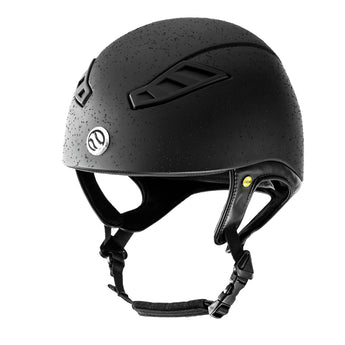
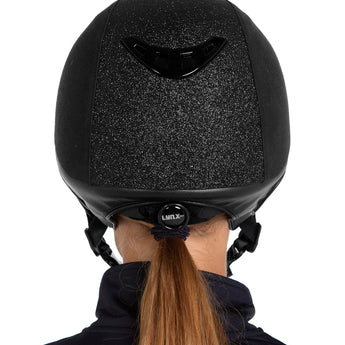
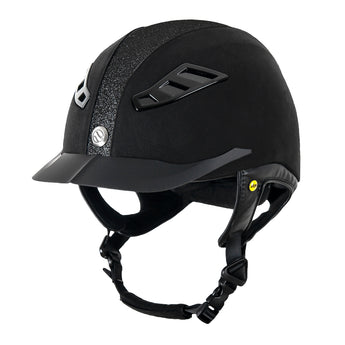
The Back on Track Trauma Void™ Lynx and Lynx Eventing helmets are SEI certified to ASTM F1163-23. SEI documentation confirms that annual certification testing is part of the program.
In Europe, EN 1384:2023 establishes another set of performance requirements for equestrian helmets. The Back on Track Caracas has been tested according to EN 1384:2023 and holds EU type-examination certification through TÜV SÜD Danmark.
These certifications matter.
But research into equestrian head impacts also suggests there is more to the story.
Why Rotational Motion Matters
A real fall from a horse isn't necessarily a straight vertical impact.
A rider can hit the ground at an angle, causing the head to rotate rapidly.
That distinction matters because the brain responds differently to different types of motion. Biomechanical research has associated linear acceleration with pressure-related loading within the brain, while rotational acceleration can increase brain tissue strain.
Equestrian-specific research has therefore argued that angular — or rotational—kinematics deserve greater consideration when evaluating helmet performance.
One finite-element study of equestrian helmet impacts found that improvements in linear acceleration measurements did not necessarily correspond to equivalent reductions in brain tissue stress and strain. The researchers recommended that angular kinematics be considered when assessing equestrian helmets. More recent research reinforces that point.
A large study developing the Virginia Tech Equestrian STAR methodology conducted 720 helmet impact tests and assessed both linear and rotational head acceleration. Researchers found that performance during linear and oblique impact testing was not necessarily closely related. Most strikingly, their combined testing methodology estimated nearly a four-fold difference in concussion risk between the best- and worst-performing helmets tested.
In other words: helmets can perform differently — even when they're all riding helmets.
Where Mips® Comes In
This is one reason we're interested in Mips® technology.
Mips is a rotational-impact management system designed to permit a small amount of movement between the helmet and head during certain angled impacts, with the goal of reducing rotational motion transferred to the head.
The concept has been studied independently outside equestrian sport as well.
In one laboratory study comparing the same bicycle helmet with and without Mips, researchers found that the Mips-equipped condition reduced peak angular acceleration and angular velocity across several oblique-impact orientations.
A broader scientific review of bicycle helmet impact testing similarly found that helmets using Mips rotational-damping technology demonstrated significantly lower peak rotational acceleration than conventional EPS helmets within the testing data analyzed.
That doesn't mean Mips can prevent concussion or eliminate the possibility of brain injury. No helmet or technology can make that promise. It does mean rotational motion is an important part of the helmet-safety conversation.
Certification Is the Beginning. Independent Testing Can Tell Us More.
This is where independent helmet testing becomes particularly valuable.
The Virginia Tech Helmet Lab evaluates equestrian helmets using its STAR methodology, incorporating both linear and rotational head kinematics into its assessment of helmet performance.
This testing doesn't replace ASTM, SEI, EN 1384, or other certification standards. It provides riders with additional information they can use when comparing individual helmets.
And that's exactly what we encourage riders to do.
- Don't assume the most expensive helmet is automatically the safest.
- Don't assume the helmet you've always worn offers the same protection as another model.
- And don't choose a helmet based solely on how it looks in the show ring.
Look at the certification. Look at the technology. Look for independent testing. Ask questions.
Then make an informed decision about what you're putting on your head.
At Back on Track USA, our Trauma Void™ helmets are designed around a simple philosophy:
You shouldn't have to choose between looking good and protecting yourself.
Because when it comes to your helmet, the technology underneath the finish matters a whole lot more than the finish itself.
References
ASTM International. ASTM F1163-23: Standard Specification for Protective Headgear Used in Horse Sports and Horseback Riding.
Connor TA, Clark JM, Jayamohan J, et al. Do equestrian helmets prevent concussion? A retrospective analysis of head injuries and helmet damage from real-world equestrian accidents. Sports Medicine – Open. 2019;5:19.
Forero Rueda MA, Cui L, Gilchrist MD. Finite element modelling of equestrian helmet impacts exposes the need to address rotational kinematics in future helmet designs. Computer Methods in Biomechanics and Biomedical Engineering. 2011;14(12):1021–1031.
Clark JM, Post A, Hoshizaki TB, Gilchrist MD. The influence of impact surface on head kinematics and brain tissue response during impacts with equestrian helmets. Proceedings of the Institution of Mechanical Engineers, Part P: Journal of Sports Engineering and Technology. 2020.
Rowson S, et al. Equestrian STAR: Development of an Experimental Methodology for Assessing the Biomechanical Performance of Equestrian Helmets. Annals of Biomedical Engineering. 2025.
Bland ML, McNally C, Zuby DS, Mueller BC, Rowson S. Differences in impact performance of bicycle helmets during oblique impacts. Journal of Biomechanical Engineering. 2018.
Ghajari M, et al. Research examining rotation-damping helmet technologies and rotational head kinematics during oblique impacts.
Virginia Tech Helmet Lab. Equestrian Helmet Ratings and STAR Methodology.